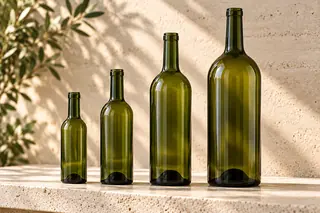
How is a champagne bottle different from a still wine bottle?
The difference is pressure. A still wine bottle holds wine at roughly atmospheric pressure, while a fully sparkling wine pushes outward on every square millimeter of glass. The bottle is engineered for that load:
- Thicker walls, especially in the shoulder and base.
- A deep punt that spreads stress across the base.
- A rounded, smooth profile without sharp corners, where stress would concentrate.
- A reinforced neck lip that anchors the wire cage.
"Champagne" is a protected designation for sparkling wine from the Champagne region of France, so most producers elsewhere label their product "sparkling wine" or use their own regional name. Confirm the labeling rules for your market. The bottle style, though, is shared across most sparkling wines.
How much pressure does a sparkling wine bottle hold?
| Style | Typical pressure | Approx. psi | Bottle needs |
|---|---|---|---|
| Traditional method (bottle-fermented) | About 5–6 bar | 72–87 psi | Full sparkling wine bottle, cork and cage |
| Tank method sparkling | Often about 3–5 bar | 43–72 psi | Sparkling wine bottle rated for the pressure |
| Semi-sparkling (frizzante) | About 1–2.5 bar | 15–36 psi | Pressure-rated bottle, sometimes screw cap or string-tied cork |
| Still wine | Near atmospheric | – | Standard still wine bottle |
EU rules distinguish sparkling from semi-sparkling wine by pressure thresholds, and other markets have their own definitions and tax categories. Check current rules for each market, because the category can change your excise duty and label.
What are pressure safe bottles?
A pressure safe bottle is one designed and tested for a stated internal pressure, with a safety margin. For any carbonated or bottle-conditioned product, ask your supplier for the rated pressure and test data. Never put sparkling wine, cider or other refermented drinks into decorative, still-wine or unrated bottles: glass that is not designed for pressure can burst and injure people.
What sizes do champagne bottles come in?
Sparkling wine uses the same size names as other wine, from mini bottles up to very large formats.
| Name | Capacity | US fl oz (approx.) | Standard bottles |
|---|---|---|---|
| Quarter / piccolo / mini | 187 ml or 200 ml | 6.3 or 6.8 | 1/4 |
| Half | 375 ml | 12.7 | 1/2 |
| Standard | 750 ml | 25.4 | 1 |
| Magnum | 1.5 L | 50.7 | 2 |
| Jeroboam | 3 L | 101.4 | 4 |
| Methuselah | 6 L | 202.9 | 8 |
| Nebuchadnezzar | 15 L | 507.2 | 20 |
Some very small and very large formats are filled by transferring finished wine rather than fermenting it in that bottle. For the full list of names and the dimensions of still-wine sizes, see our wine bottle sizes guide.
Champagne bottle dimensions
A 750 ml sparkling wine bottle is typically about 295–310 mm (11.6–12.2 in) tall and 86–90 mm (3.4–3.5 in) in diameter. That extra width compared with a Bordeaux bottle matters for gift boxes, ice buckets, wine racks and case dividers. Empty weight is commonly around 800–900 g (28–32 oz). Always confirm with the drawing of the specific bottle.
Why are mini champagne and prosecco bottles so popular?
Mini champagne bottles and mini prosecco bottles are bought for weddings, parties, hotel minibars, airlines, gift baskets and corporate events. One mini is roughly one to one and a half glasses, so there is no leftover open bottle. Packs of 4, 12 and 24 are common at retail, and event planners often buy small champagne bottles in bulk by the case.
For a producer, minis bring extra work:
- Closure: many minis use a crown cap or a screw cap rather than a cork and cage, which is cheaper at this size and easy to open.
- Filling: small formats need suitable filler change parts and can be slower to run.
- Packaging share: glass, closure and label cost almost as much per unit as on a full bottle, so cost per liter rises.
- Shelf presence: mini rosé and pink sparkling wines often use clear or lightly tinted glass to show the color.
What color are champagne bottles?
Most sparkling wine bottles are dark green, sometimes called antique green. Sparkling wine is very sensitive to light-struck off-flavors, and dark green or amber glass filters more of the damaging light than clear glass. Clear bottles are mainly used for rosé and some premium cuvées, often sold in gift boxes, sleeves or wraps that block light. For more on how glass color protects wine, see our guide to wine bottle shapes and colors.
How do champagne corks and cages work?
A sparkling wine cork starts as a straight cylinder, typically around 30–31 mm (about 1.2 in) in diameter, and is compressed hard into a bore of roughly 17.5–18.5 mm (about 0.7 in). The part outside the neck spreads into the familiar mushroom shape, and the wire cage (muselet) with its small metal cap holds it in place against the pressure.
Common sparkling closures:
- Agglomerated cork with natural cork discs: traditional for quality sparkling wine.
- Technical or microagglomerated cork: consistent, often treated to reduce cork taint risk.
- Plastic or synthetic stoppers: lower cost, common on value sparkling wines.
- Crown caps: used on many minis, and during bottle fermentation in traditional-method production before the final cork goes in.
Sparkling wine closures are a different system from the bar-top and still-wine corks covered in our cork stoppers guide, and crown caps are explained in our bottle caps guide.
Safety when opening
Keep a hand over the cork once the cage is loosened, point the bottle away from people, and twist the bottle rather than the cork. A cork released under full pressure can travel fast enough to cause eye injuries.
How should you package sparkling wine as a gift?
A champagne gift box or tube protects the bottle from light and knocks and gives space for branding. Because sparkling wine bottles are wider and heavier than still-wine bottles, check inner dimensions and insert strength against the actual bottle. Rigid boxes with molded inserts suit premium 750 ml and magnum bottles, while printed cartons work for mini packs. See our range of gift boxes and tubes and the liquor gift boxes guide for structure options.
How do you source sparkling wine bottles?
Sparkling wine bottles are specialty items: they need controlled wall thickness, annealing and pressure testing. When you source them, ask for:
- The rated pressure and test method, with test reports for your lot.
- The neck finish drawing, confirming it accepts your cork, cage and, if used, crown cap.
- Empty weight, dimensions and tolerances.
- Pallet configuration and packing that protects the necks in transit.
Plan timing early. Pressure-rated bottles are usually made in scheduled runs, and decorated or custom-colored bottles add sampling and approval steps before production. If you are launching a mini format for events or a magnum for the holiday season, work back from your bottling date and allow for sea freight. Our guide to MOQs and lead times explains how to build that schedule and what drives minimum order quantities.
Mars Glass does not list sparkling wine bottles as stock items, but we can quote them as custom or sourced items alongside decoration, closures and gift packaging. Our still wine bottles are not pressure-rated and should not be used for sparkling products.
Key takeaways
- A champagne bottle is built to hold about 5 to 6 bar (72 to 87 psi) of pressure, so it is thicker, heavier and wider than a still-wine bottle.
- The standard size is 750 ml; mini champagne bottles are usually 187 ml or 200 ml.
- Most sparkling wine bottles are dark green to protect against light-struck flavors.
- Mushroom corks and wire cages are the classic closure; minis often use crown or screw caps.
- Only use bottles designed and rated for pressure, and confirm test data with your supplier.
How Mars Glass can help
Mars Glass, in Shanghai, quotes custom and sourced bottles within one business day and can add screen printing, decals, frosting, spray coating or hot stamping, with production checked against the approved sample.
Frequently asked questions
What size is a mini champagne bottle?
Mini champagne and sparkling wine bottles are usually 187 ml (about 6.3 US fl oz), a quarter of a standard bottle, or 200 ml (about 6.8 fl oz). Which one is used depends on the producer and the market the wine is sold in.
What is the standard size of a champagne bottle?
The standard champagne bottle holds 750 ml, about 25.4 US fl oz. It is typically about 295 to 310 mm (11.6 to 12.2 inches) tall and 86 to 90 mm (3.4 to 3.5 inches) wide, which is wider than a still wine bottle because of its thicker walls.
How much pressure is in a champagne bottle?
Traditional-method sparkling wine is typically around 5 to 6 bar, roughly 72 to 87 psi, or about two to three times the pressure in a car tire. That is why sparkling wine bottles are heavy and must be specifically designed and rated for pressure.
Why are champagne bottles so heavy?
The thick walls and deep punt let the bottle hold several bar of internal pressure safely through filling, aging, shipping and temperature changes. A 750 ml sparkling wine bottle commonly weighs around 800 to 900 g empty, against roughly 400 to 550 g for many still-wine bottles.
What is a champagne cork made of?
Most sparkling wine corks are made of agglomerated cork granules, often with one or more discs of natural cork at the end touching the wine. Synthetic and plastic stoppers are also used, especially for lower-priced sparkling wines, and all are held in place by a wire cage.
Can I use a regular wine bottle for sparkling wine?
No. Still wine bottles are not designed for the internal pressure of sparkling wine and can burst. Only use bottles designed and rated for sparkling wine, and fill and close them with closures made for that finish.