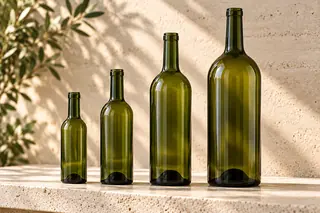
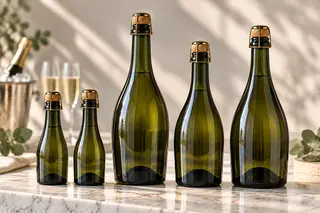
What are the main wine bottle shapes?
Each traditional shape grew up in a wine region, and buyers still read them as signals of grape and style. Nothing stops you from putting any wine in any shape, but matching expectations makes the shelf story easier.
| Shape | Silhouette | Typical wines | 750 ml diameter (approx.) |
|---|---|---|---|
| Bordeaux | Straight cylinder, high sharp shoulders | Cabernet Sauvignon, Merlot, Sauvignon Blanc, blends | 73–78 mm (2.9–3.1 in) |
| Burgundy | Wider body, gently sloping shoulders | Pinot Noir, Chardonnay, Syrah | 80–85 mm (3.1–3.3 in) |
| Rhône | Similar to Burgundy, often slimmer, sometimes embossed | Grenache, Syrah blends | 78–82 mm (3.1–3.2 in) |
| Flute (Alsace / Mosel / Rhine) | Tall and slim with a long taper | Riesling, Gewürztraminer | 72–78 mm (2.8–3.1 in) |
| Sparkling | Heavy, thick walls, deep punt | Traditional and tank-method sparkling | 86–90 mm (3.4–3.5 in) |
| Port / fortified | Sturdy body with a bulge in the neck | Port, fortified and dessert wines | Varies |
Heights for each size are covered in our wine bottle sizes guide; this article focuses on the profile and glass.
Bordeaux bottle
The Bordeaux bottle's high shoulders are often said to help catch sediment when pouring older reds. Its straight sides give a large, flat label panel and make it easy to run on labelers, which is one reason it is the most widely used shape worldwide. Mars Glass lists a Bordeaux-style wine bottle with screw cap in 187, 375 and 750 ml, in flint or amber.
Burgundy bottle
The Burgundy bottle is older in style and wider, with shoulders that flow into the neck. It reads as traditional and is the usual choice for Pinot Noir and Chardonnay. Our antique green Burgundy wine bottle comes in 375, 750 and 1,000 ml for cork closures.
Flute, sparkling and regional shapes
The flute is the tall, slender bottle traditionally used in Germany and Alsace. Sparkling wine bottles are a category of their own because they must hold pressure; see our champagne and sparkling wine bottles guide. Some regional shapes, such as the flattened round Bocksbeutel, are protected for specific regions in the EU, so check before you copy a traditional shape for an export product.
What color are wine bottles, and why?
Light, especially UV and blue light, can cause "light-struck" off-flavors in wine, most noticeably in whites, rosés and sparkling wines. Glass color is your main defense.
| Glass color | Light protection | Typical use |
|---|---|---|
| Amber (brown) | Highest; filters most UV and much blue light | Some German whites, natural wines, brands that want maximum protection |
| Dark green (antique green) | Good | Red wines, many whites and sparkling wines |
| Light green / dead-leaf | Moderate | Whites, traditional Burgundy and Loire styles |
| Blue (cobalt) | Low to moderate | Aromatic whites, branding-led products |
| Clear (flint, super flint) | Low | Rosé, young whites, dessert wines, any wine where color is part of the appeal |
A "red wine bottle" is usually dark green, because reds are often aged and green glass is traditional. Clear wine bottles are popular for rosé because the pink color sells the wine on shelf. If you choose clear, pay attention to the clarity of the glass itself; our guide to flint, super flint and extra flint glass explains how iron content changes the tint.
Does color protect wine fully?
No color gives complete protection. Bottles in closed cases, in a cool and dark warehouse, are far better protected than any bottle under bright display lights. For clear or blue glass, many producers also use shrink sleeves, gift boxes or tissue wraps for extra protection.
How heavy should a wine bottle be?
Glass weight affects cost, freight, carbon footprint and perceived quality. Typical 750 ml still-wine bottles fall into broad bands:
- Lightweight: roughly 350–420 g (12–15 oz). Lower freight cost and emissions, widely used for everyday wines.
- Standard: roughly 450–550 g (16–19 oz). The most common range.
- Premium heavy: roughly 600–900 g (21–32 oz). Thicker base and deeper punt, used for high-priced wines.
Many wineries and retailers are moving toward lighter bottles for sustainability reasons, while some premium brands still use heavy glass as a quality signal. Sparkling bottles are heavier for safety, not image, so do not lightweight them. For more on glass and the environment, see sustainable glass packaging.
What is the punt for?
The punt is the dome pushed up into the base of many wine bottles. It strengthens the base, which is essential in sparkling wine bottles, helps the bottle stand steadily on uneven surfaces, and can collect sediment in older reds. A deep punt also makes a bottle look larger and heavier, which is why it appears on premium still wines too.
How do shape and color affect labels, cartons and gift packaging?
Shape decides much of your downstream packaging. A Bordeaux bottle has a long straight body, so wraparound labels apply easily and standard 12-bottle dividers fit well. A Burgundy bottle's sloping shoulders leave a shorter flat panel, so front labels are usually smaller and placed lower. Tall flutes may not fit standard cases, racks or refrigerator doors, which matters for retail listings.
Color changes how labels read. White and light labels stand out on dark green and amber glass, while clear glass shows the wine and the back of the label through the bottle, so many brands print the inside face of clear labels or use opaque stock. For gift sets and single-bottle presentation, check the inner dimensions of the gift box against the bottle drawing, including the closure height.
Should a wine bottle use a cork or a screw cap?
The closure is decided by the bottle's finish, so you choose it together with the shape. Bottles made for corks have a smooth bore designed to grip a cork; screw cap wine bottles have an external thread finish for a long aluminum cap. One finish cannot simply be swapped for the other. The trade-offs between the two are covered in our cork stoppers guide, including the screw cap vs cork question.
Can you customize the shape and color of a wine bottle?
Yes, within limits. A stock shape can usually be decorated with screen printing, decals, frosting, spray coating or hot stamping, and an embossed logo can be added on a new or modified mold. A fully custom shape needs a new mold, samples before mass production and a higher minimum order. Glass color is set in the furnace, so unusual colors are often achieved on stock flint bottles with spray coating instead.
Where do wineries buy empty wine bottles wholesale?
Small home winemakers usually buy empty wine bottles by the case from homebrew suppliers. Wineries and brands buy wholesale wine bottles by the pallet or container from glass factories and distributors. When you compare suppliers, ask for:
- The bottle drawing with height, diameter, finish and tolerances.
- The glass weight and color specification.
- Matching closures tested on the actual bottle.
- Pallet and container loading data, so you can calculate landed cost.
Key takeaways
- Bordeaux, Burgundy, flute and sparkling are the four core wine bottle shapes, each with typical grapes and styles.
- Diameter differs by shape: about 73–78 mm for Bordeaux and 80–85 mm for Burgundy at 750 ml.
- Amber and dark green glass protect wine from light best; clear and blue glass suit wines sold and drunk young.
- Lighter bottles cut freight and emissions; sparkling bottles must stay heavy for pressure safety.
- The neck finish fixes the closure type, so choose cork or screw cap together with the bottle.
How Mars Glass can help
Mars Glass supplies stock and custom wine bottles from Shanghai, with closures matched to each finish, decoration on the bottle, and samples before mass production for custom designs.
- Browse wine bottles
- Extra flint Bordeaux wine bottle with screw cap, 187–750 ml
- Request samples or a quote
Frequently asked questions
What are the main wine bottle shapes?
The main shapes are Bordeaux (straight sides and high shoulders), Burgundy (wider body and sloping shoulders), the tall slim flute used for aromatic whites such as Riesling, and the heavy sparkling wine bottle. Regional shapes such as the flattened round Bocksbeutel and the bulbous-necked port bottle are also used.
Why are most wine bottles green?
Green glass filters part of the light that can damage wine and cause off-flavors, and it has long been the traditional color for red wine. Amber glass filters even more UV and blue light, while clear glass offers little protection but shows the wine's color.
How wide is a wine bottle?
A 750 ml Bordeaux bottle is typically about 73 to 78 mm (2.9 to 3.1 inches) in diameter. Burgundy bottles are wider, usually about 80 to 85 mm (3.1 to 3.3 inches), and sparkling wine bottles about 86 to 90 mm (3.4 to 3.5 inches).
Can I buy empty wine bottles in bulk?
Yes. Wineries and winemakers buy empty wine bottles by the pallet or container from glass suppliers, and stock wine bottles usually have MOQs from a few thousand to over 100,000 pieces. Small home winemaking quantities are usually bought from homebrew retailers instead.
Are blue wine bottles bad for wine?
Blue glass protects wine less from light than green or amber glass, so it is mostly used for whites and rosés meant to be drunk young and sold quickly. If you choose blue for branding, keep cases closed in storage and avoid long display under strong lighting.
Does the shape of a wine bottle affect the wine?
The shape itself has little effect on the wine. Shape signals style and region to the buyer, and it affects practical things such as how well bottles stack, how sediment collects, which labels fit, and what racks and cartons you need.