What does a typical whiskey bottle look like?
Most whiskey bottles fall into four families:
- Square bottles: strong shoulders, flat label panels, a confident back-bar presence. Common for bourbon and American whiskey.
- Tall round bottles: classic for scotch and Irish whiskey, with long necks and wrap labels.
- Flask bottles: flat and pocket-shaped, used for 200 ml and 375 ml sizes and some full-size bottles.
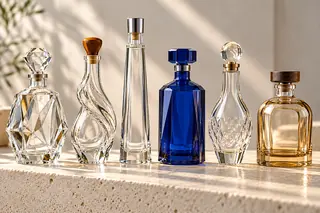
- Decanter-style bottles: short, wide and heavy, with a large stopper, used for premium and limited releases.
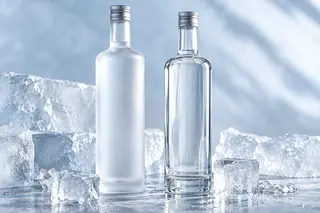
Whatever the shape, the glass is almost always clear. The spirit's amber color is a selling point, and dark glass would hide it.
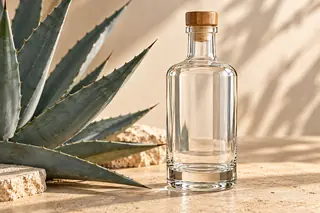
The closure is usually a bar-top cork stopper, with a synthetic or natural cork shank in sizes such as 19.5 mm or 21.5 mm and a head in wood, zinc alloy, acrylic or glass. Some brands dip the top in wax for a hand-finished look. Value whiskies and high-speed lines often use aluminum ROPP or screw caps instead, which apply faster and show a tamper band. Whichever you choose, order the bottle and closure together and test the fit with your product.
What size is a whiskey bottle?
Bottle size follows the market. The US standard is 750 ml, while the UK and EU use 700 ml. A brand exporting to both usually runs two bottle sizes or a single mold family with two capacities.
| Size | US fl oz | Typical whiskey use |
|---|---|---|
| 50 ml | 1.7 | Sample bottles, tasting kits, minis |
| 200 ml | 6.8 | Flask, gift sets |
| 375 ml | 12.7 | Half bottle, limited releases |
| 700 ml | 23.7 | Scotch and whisky for UK and EU |
| 750 ml | 25.4 | Bourbon and whiskey for the US |
| 1 L | 33.8 | Duty-free, bars |
| 1.75 L | 59.2 | Large format, value brands |
Bottles of 1.5 L and larger appear as limited editions or display pieces, and are usually custom projects. For the rules behind these sizes, see our liquor bottle sizes guide.
How do bourbon and scotch bottles differ?
Neither bourbon nor scotch rules dictate a bottle shape, but each category has visual habits buyers recognize.
Bourbon bottles lean toward square or squat forms, heavier glass, embossed shoulders or bases, and closures that feel crafted: wooden-head corks or wax dipping. Many craft distillers choose a heavy-base square bottle so the brand reads as premium even at a modest price.
Scotch bottles more often use tall round or slightly squared bottles, with paper labels and a gift tube or carton. Single malts frequently use clear glass to show natural color, and some blends use colored or coated glass.
Spelling follows the same pattern: whisky is typical for Scotland and Canada, whiskey for Ireland and the US. Match the spelling on your packaging to your category and market, and confirm labeling rules with your regulator.
Which glass should you choose for a whiskey bottle?
Clarity
Standard flint is the most economical clear glass. Super flint has lower iron, so it looks brighter and does not tint the whiskey green at the base. For aged spirits sold on their color, super flint is usually worth it. Compare both side by side with your actual whiskey before you decide.
Weight and base
Heavy bases give a satisfying weight and a lens effect under bar lighting. A faceted square super flint spirit bottle with heavy base is a typical example. Remember that every extra 100 g (3.5 oz) of glass adds cost per bottle and weight per container.
Color
A blue bottle whiskey or a black matte bottle is usually created with spray coating on clear glass. It suits flavored whiskies and special editions, but it hides the liquid, so most core ranges stay clear.
What makes whiskey bottles unique or collectible?
Collectors and gift buyers look for bottles that feel special. Common features of unique whiskey bottles and limited edition whiskey bottles include:
- Embossed logos, dates or batch details molded into the glass.
- Decanter-style forms with glass or metal-head stoppers.
- Engraved or etched individual numbering.
- Commemorative decoration in precious-metal colors by hot stamping or printing.
- Wooden, leather or rigid paper presentation boxes.
Our articles on unique liquor bottle designs and liquor decanters cover these formats in more depth.
Old whiskey bottles
Old whiskey bottles are collected for their history. Mouth-blown bottles typically show uneven walls and seams that stop below the lip; machine-made bottles from the early 20th century onward have seams that run through the finish. US liquor bottles from roughly the mid-1930s to the mid-1960s often carry an embossed statement that federal law forbids sale or reuse of the bottle. Many modern brands borrow these cues, such as embossed shoulders and heavy bases, for heritage-style bottles.
What are whiskey sample bottles and flasks?
Whiskey sample bottles are small bottles used for trade samples, tasting kits and gift sets. The 50 ml mini is standard; it holds 1.7 fl oz. Brands often use a 50 ml mini Oslo bottle with an ROPP cap, or flat bottles that pack neatly into a box.
A whiskey flask bottle, typically 200 ml or 375 ml, is a flat shape with a short neck. Our flat glass bottle for spirits, 50–250 ml is suited to minis and flasks. For more detail, see our mini liquor bottles guide.
Does a whiskey bottle need a gift box?
Whiskey is one of the most gifted spirits, so many brands pair the bottle with a whiskey gift box, bourbon gift box or kraft tube. A rigid box protects the glass, gives extra space for brand story and can include a molded insert for the bottle plus two glasses for a whiskey bottle and glass set.
Size the box from the final bottle drawing, including the stopper height. A rigid paper whiskey gift box with foil and spot UV is a common choice for premium releases.
How much does a custom whiskey bottle cost?
Reference FOB prices for stock 500–750 ml spirits bottles in our catalog range from about $0.22 to $0.80 per piece before closure, decoration and freight. Custom whisky bottles add a one-time mold cost and usually need higher minimum orders than stock bottles, which start at 5,000 pieces on many of our spirits items.
To control cost, start from a stock mold and personalize it with embossing or decoration, or develop a private mold only for your flagship size. Our guide on designing a custom spirits bottle walks through drawings, samples and approval.
Key takeaways
- Standard whiskey bottles are 750 ml (25.4 fl oz) for the US and 700 ml (23.7 fl oz) for the UK and EU.
- Bourbon and scotch bottles follow conventions, not legal shape rules.
- Super flint glass shows amber color best; heavy bases add premium feel and cost.
- Sample bottles are typically 50 ml minis; flasks are usually 200 or 375 ml.
- Gift boxes and tubes are part of whiskey packaging, so size them from the final bottle drawing.
- Start from a stock mold with embossing or decoration to keep custom costs under control.
How Mars Glass can help
Mars Glass supplies stock and custom whiskey bottles, cork stoppers and gift boxes from Shanghai. We can build a mold from your drawing or reference bottle, send samples before mass production and ship FOB or CIF from the Port of Shanghai.
- Browse our spirits bottles for square, round and heavy-base designs.
- Contact us for a quote within one business day.
Frequently asked questions
What size is a standard whiskey bottle?
In the United States the standard whiskey bottle is 750 ml, about 25.4 US fl oz. Scotch and other whisky sold in the UK and EU is usually bottled at 700 ml, about 23.7 fl oz. Liter, 375 ml, 200 ml and 50 ml bottles are also common.
What is the difference between a bourbon bottle and a scotch bottle?
There is no required bottle shape for either spirit. By convention, many bourbon bottles are squat or square with heavy glass, embossing and wax or cork closures, while many scotch bottles are taller and rounder and often sold in a tube or gift box. The main practical difference is size: 750 ml for the US market and 700 ml for the UK and EU.
How can you tell how old a whiskey bottle is?
Look at the seams, the base and any embossing. Mouth-blown bottles from before machine production usually show uneven glass and seams that stop below the lip, while machine-made bottles have seams running up through the finish. US liquor bottles from roughly the mid-1930s to the mid-1960s often carry an embossed notice that federal law forbids sale or reuse of the bottle.
What size are whiskey sample bottles?
Whiskey sample bottles are usually 50 ml (1.7 fl oz) miniatures, with some distilleries using 20 ml, 30 ml or 100 ml formats for tasting kits. Flat or round minis with screw or ROPP caps are the most common for trade samples and gift sets.
How much does an empty whiskey bottle cost?
Stock 700 to 750 ml spirits bottles often have factory prices of roughly $0.22 to $0.80 per piece, depending on weight, glass clarity and finish. Cork stoppers, decoration, gift boxes and freight are extra, and custom molds add a one-time tooling cost.
Can I get a custom whiskey bottle with my logo embossed?
Yes. An embossed logo is molded into the glass, so it needs a custom or modified mold. The factory makes the mold from your drawing, sends samples for approval, then runs production against that approved sample.