This article goes deeper on these two processes. For a side-by-side view of every method, including decals, spray coating and embossing, see our glass bottle decoration methods comparison.
How does screen printing on glass bottles work?
A typical bottle screen printing run follows these steps:
- Artwork and films. Vector artwork is separated into one layer per color, and a film positive is made for each.
- Screen making. A mesh screen is coated with light-sensitive emulsion and exposed through the film. The unexposed areas wash out, leaving open mesh where ink should pass.
- Setup. The bottle sits in a holder that rotates it under the screen. A notch, lug or mold seam is used to register the bottle so every print lands in the same place.
- Printing. A squeegee pushes ink through the mesh while the screen and bottle move together, so the image rolls onto the curved surface.
- Drying or curing between colors, then a final cure or firing.
- Inspection against the approved sample for position, color, coverage and defects.
Because the bottle rolls under a flat screen, screen printing works best on cylinders and flat panels. Tapered, oval and sharply shaped bottles need special fixtures or may limit the print area.
Ceramic or organic ink: which should you choose?
The ink system decides durability, color range and price more than any other choice.
| Factor | Ceramic (enamel) ink | Organic ink (UV or low-temp) |
|---|---|---|
| Curing | Fired in a lehr, typically around 550–650 °C (1,020–1,200 °F) | UV lamps or baking at much lower temperature |
| Bond | Fuses into the glass surface | Adheres to the surface |
| Abrasion and ice-bucket resistance | Very high | Medium to high, depends on ink and primer |
| Color range | Narrower; brights and exact matches are harder | Wide, including vivid colors and special effects |
| Metallics | Precious-metal lusters possible but costly | Metallic inks, or combine with hot stamping |
| Typical uses | Spirits, beer, returnable and reusable bottles | Spirits, cosmetics, diffusers, colored effects |
Ceramic inks contain glass frit and pigment. Many are thermoplastic, meaning they are printed hot and set as they cool, so several colors can be printed one after another and fired once. Ask for lead-free and heavy-metal-compliant formulations for your market.
Organic inks cure without high heat, so they work on bottles that are already spray coated or frosted and on colors that ceramic systems cannot reach. They are the usual choice when the print must match a bright brand color.
What artwork rules apply to glass bottle printing?
Good artwork avoids most print problems. Send these with your request:
- Vector files (AI, EPS or PDF with outlined fonts), one layer per color.
- Pantone references for each color, and a note on which colors must match closely.
- A placement drawing on the bottle drawing, with distances from the base or shoulder in mm and inches.
- Fine lines and small text. Very thin strokes can break up or fill in. As a rule of thumb, keep lines at roughly 0.2–0.3 mm (about 0.01 in) or thicker and test the smallest text on samples.
- Print zone limits. Keep artwork on the straight wall, clear of the shoulder curve, the heel and the mold seams.
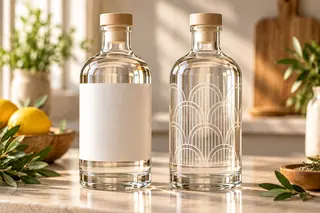
Two design ideas work especially well on clear glass. Printing on the back panel lets the design show through the liquid from the front. A 360° wrap print can cover the whole body, but it needs a seam-free gap or a careful join where the print meets itself.
How much does screen printing glass bottles cost?
Price depends mostly on setup and on the number of passes. The main cost drivers are:
- Number of colors — each one adds a screen, a pass and a registration risk.
- Number of print positions — front, back and neck each count separately.
- Ink system — precious-metal ceramic lusters cost far more than standard colors.
- Bottle shape — awkward shapes need fixtures and run slower.
- Order size — setup cost is spread over the run, so short runs cost more per bottle.
Because each design has a setup, decorated bottles are usually ordered in production quantities that follow the bottle MOQ. Our MOQ and lead times guide explains how decoration affects both. If you need many designs in small volumes, compare the numbers in our labels vs direct printing guide.
Can frosted glass bottles and jars be screen printed?
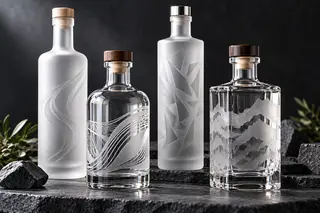
Yes, and the combination is one of the most popular premium looks. Frosted glass bottles and frosted glass jars are printed after frosting, usually with organic inks, though some ceramic systems work too. White, black and metallic prints stand out well on the matte surface.
Two points to test: fine detail looks slightly softer on a frosted surface, and fingerprints or oils can mark some frosted finishes. Frosted candle jars, frosted jars with lids for cosmetics and frosted water bottles all use this approach. Our round flint glass water bottle in frosted glass, 200–1000 ml and frosted square reed diffuser jar are examples of stock frosted items that can be printed.
Why do hotels and brands use printed bottles of water?
Restaurants, hotels and offices that refill glass water bottles use screen printed bottles for branding that survives repeated washing. For reusable bottles that go through commercial dishwashers, fired ceramic ink is the safer choice, because organic inks can wear with repeated hot alkaline washing. Test with your actual dishwasher cycle before ordering in volume. The same logic applies to returnable beverage bottles.
What is hot stamping and how does the process work?
Hot stamping, also called hot stamp printing or hot foil stamping, transfers a thin metallic layer from a foil roll to the product using heat and pressure. A hot stamping foil is a multilayer film:
- a polyester carrier film,
- a release layer,
- a lacquer layer that sets the color, such as gold, silver, rose gold or a colored metallic,
- a vacuum-metallized aluminum layer that gives the shine,
- a heat-activated adhesive layer.
The hot stamping process runs in three steps. A heated die, often silicone for curved glass, presses the foil against the surface. Heat activates the adhesive, which bonds where the die touches. When the die lifts, the carrier peels away and leaves the metallic image.
The term "hot stamp type" comes from the same process: letters or a logo plate are mounted in the stamping head, which is how hot foil stamping is used on paper, leather and gift boxes. On glass bottles the die is usually a custom plate made from your logo.
When should you use hot stamping on glass bottles?
Hot stamping gives a brighter, more mirror-like metallic than metallic ink, with crisp edges. It suits logos, borders, neck bands and small accents. Keep in mind:
- Surface. It works best on flat panels or simple curves. Deep curves and textured glass make even contact difficult.
- Base layer. On glass, foil is often stamped onto a printed or coated base that gives it a better surface to bond to.
- Area. Very large solid areas can show pinholes or uneven shine; use foil for accents.
- Durability. Foil is less abrasion-resistant than fired enamel. Use dividers or sleeves when packing.
A common premium combination is spray coating, then a screen-printed white or black layer, then a hot-stamped gold logo. Each step adds a quality checkpoint and lead time.
Can bottle caps and gift boxes be printed to match?
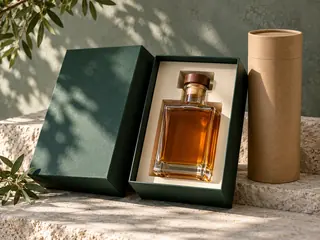
Yes, and matching all three parts makes the pack look intentional. Custom printed bottle caps are usually aluminum ROPP or screw caps printed or embossed on the top and side; see our aluminum ROPP cap with custom printing. Gift boxes commonly use the same foil color as the bottle, applied by hot foil stamping on the paper. Send all Pantone and foil references together so the supplier can match them.
Key takeaways
- Screen printing on glass prints one color per pass through a mesh stencil, then cures or fires the ink.
- Ceramic ink is fired into the glass for top durability; organic ink gives brighter colors on coated or frosted bottles.
- Keep artwork on straight walls, avoid very thin lines, and limit colors to control cost.
- Hot stamping adds bright metallic foil using heat and pressure; it suits accents on flat or gently curved areas.
- Approve physical samples and test adhesion, soaking and abrasion before production.
How Mars Glass can help
Mars Glass decorates bottles and jars in Shanghai by screen printing, decals, frosting, spray coating, hot stamping and embossing, and checks production against the approved sample with photos and measurements. Send your artwork and bottle choice for a quote within one business day.
- Screen-printed clear liquor bottle with cork, 500–750 ml
- Customization and decoration options
- Send artwork for a decoration quote
Frequently asked questions
Is silk screen printing the same as screen printing?
Yes. Silk screen printing is the older name, from when screens were made of silk. Modern screens use polyester or similar synthetic mesh, but the process of pushing ink through a stencil in the mesh is the same.
How durable is screen printing on glass bottles?
Fired ceramic enamel prints fuse into the glass surface and resist ice buckets, washing and abrasion very well. Organic UV-cured or low-temperature inks are durable for normal retail use but less resistant to scratching and strong chemicals. Ask for adhesion and soak tests on samples.
What is the hot stamping process?
A heated die presses a metallic foil against the surface. Heat and pressure activate the adhesive layer of the foil, which bonds where the die touches, and the carrier film peels away to leave a sharp gold, silver or colored metallic image.
Can you hot stamp directly on glass?
It is possible with foils and adhesives made for glass, but on bottles foil is often applied over a printed or coated base layer that gives it a better surface to bond to. Hot stamping works best on flat or simple curved areas.
How many colors can you screen print on a glass bottle?
There is no fixed limit, but each color needs its own screen, print pass and registration. Most bottle designs use one to three colors, and many brands use one or two to control cost and print risk.
Can frosted glass bottles be screen printed?
Yes. Frosted glass bottles and jars can be printed after frosting, and the matte surface makes white, black and metallic inks stand out. Fine detail can look slightly softer on a frosted surface, so test your smallest text.