What is glass made of?
How is glass made in the first place? It starts with a batch of minerals that melt together into a liquid and then cool into a rigid, non-crystalline solid. Almost all bottles and jars are made from soda-lime glass, whose main ingredients are cheap and plentiful:
| Raw material | What it supplies | Role in the glass |
|---|---|---|
| Silica sand | Silicon dioxide (SiO₂), typically around 70% or more of the glass | Forms the glass network |
| Soda ash | Sodium oxide (Na₂O) | Lowers the melting temperature |
| Limestone or dolomite | Calcium oxide (CaO), some magnesium oxide | Makes the glass durable and water-resistant |
| Cullet (recycled glass) | Ready-made glass | Melts more easily, saves energy and raw materials |
| Minor additives | Refining agents and colorants | Remove bubbles; control color |
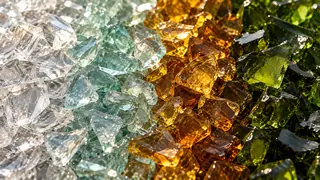
Color comes from small amounts of other elements. Iron and chromium give green glass, and iron with sulfur and carbon gives amber. Flint (clear) glass is made with low-iron sand, and super flint or extra flint glass uses even purer materials for a whiter, brighter look. Our guide to flint vs super flint vs extra flint glass explains the grades.
Borosilicate glass, used for some decanters and laboratory ware, adds boron oxide for heat resistance. It is a different material from standard bottle glass and is often shaped by hand or from tubing rather than on a bottle machine.
How is glass manufactured in the furnace?
The raw materials are weighed, mixed into a batch, and fed continuously into a large furnace. Inside, the batch melts at temperatures of roughly 1,450 to 1,600 °C (2,640 to 2,910 °F). Gases released from the soda ash and limestone form bubbles, which rise out of the melt in the refining zone.
A container glass furnace runs around the clock and is normally kept hot for many years, because cooling and reheating it would damage the refractory lining. This is one reason glass plants prefer long production runs: the furnace makes one color at a time, and changing color takes time and produces off-color glass.
From the furnace, the glass flows through channels called forehearths, where its temperature is adjusted so that it has the right viscosity for forming.
How are glass bottles made, step by step?
The glass bottle manufacturing process on a modern container line follows the same main glass manufacturing steps in almost every plant:
- Gob forming. At the end of the forehearth, a feeder pushes molten glass through an orifice, and shears cut it into gobs of exactly the weight of one bottle.
- Gob delivery. Chutes guide each gob into a section of the forming machine. Machines can cut one, two, three or four gobs at a time.
- Parison forming. In the first mold (the blank mold), the gob is shaped into a hollow preform called a parison. The neck finish is formed at this stage, in the neck ring.
- Final forming. The parison is flipped into the second mold (the blow mold), where compressed air blows it out against the mold walls. Embossed logos and lettering are formed here.
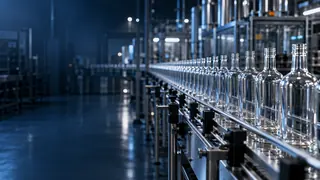
- Annealing. Bottles travel through an annealing lehr, a long oven that reheats them and cools them slowly to remove stress.
- Coating. A thin hot-end coating is applied before the lehr and a cold-end coating after it, to reduce scratching and help bottles slide on filling lines.
- Inspection and packing. Machines check every bottle, and accepted bottles are palletized or packed in cartons.
The forming machine is called an individual section (IS) machine because it is made of several identical sections that run in sequence. A large multi-gob machine can produce hundreds of small bottles per minute.
What is the difference between blow-and-blow and press-and-blow?
| Process | How the parison is formed | Typical products | Notes |
|---|---|---|---|
| Blow-and-blow process | Gob settled and blown into a parison with compressed air | Narrow-neck bottles: spirits, wine, sauces | Versatile for many shapes |
| Press-and-blow process | Metal plunger presses the gob into a parison | Wide-mouth jars, some bottles | Good control of the finish and wall thickness |
| Narrow-neck press-and-blow (NNPB) | Slim plunger presses a narrow-neck parison | Lightweight beverage bottles | Allows thinner, more even walls |
So how are glass jars made? Mostly by press-and-blow, because the plunger can form a wide mouth precisely, which matters for lug and screw lids. Jars for food are covered in our mason jar sizes guide.
Very heavy-base spirits bottles, faceted shapes and thick-walled decanters need slower cycles and careful annealing, which is one reason they cost more per piece.
How are bottles annealed and coated?
When a bottle leaves the mold, the outer surface cools faster than the inside of the wall. That difference locks stress into the glass, which can cause bottles to crack later, sometimes days after forming. In the annealing lehr, bottles are brought back up to their annealing temperature, held there, and then cooled slowly on a controlled curve.
Coatings protect the surface. The hot-end coating, often based on tin oxide, bonds to the hot glass. The cold-end coating, a thin lubricating layer, is applied once the bottles have cooled. Together they reduce scratches when bottles rub against each other on conveyors and in transport. Glass that will be screen printed or spray coated later must be compatible with the decoration process.
How is a mold for a new bottle made?
Every bottle shape needs its own set of molds, and this is where a custom bottle project spends most of its development time.
- Design. The brand supplies a drawing, a 3D model or a reference bottle. The engineers check that the shape can be formed, annealed and filled, and set the glass weight, capacity and neck finish.
- Mold design. The blank mold, blow mold, neck ring, plunger or baffle and bottom plate are designed around the bottle. Embossed logos are cut into the blow mold at this stage.
- Machining. Molds are machined from cast iron or other mold alloys, and the neck finish parts are made to tight tolerances.
- Trial run and samples. The molds are run on a forming machine to make samples, which are measured and sent for approval.
- Production set. Once samples are approved, enough mold cavities are made to run the order efficiently.
Because a shape is set by the molds, changes after approval mean new or modified tooling. Our guide to designing a custom spirits bottle explains how to brief a mold project.
How are glass bottles inspected?
Automatic inspection machines check every bottle on the line. Cameras and sensors look for:
- Dimensional faults: height, diameter, out-of-round bodies and leaning necks.
- Finish defects: chips, cracks and uneven sealing surfaces that would cause leaks.
- Glass defects: stones (unmelted particles), seeds and blisters (bubbles), and checks (small cracks).
- Wall thickness: thin spots that weaken the bottle.
In the quality lab, staff take samples from each mold cavity to measure capacity, weight and dimensions, and run tests such as thermal shock and, for carbonated drinks, internal pressure resistance. Each bottle carries a mold number on the base so a fault can be traced to its mold.
What happens after the bottle is made?
Many bottles leave the plant plain and are decorated afterward. Screen printing uses inks that are fired or cured onto the glass; frosting creates a matte surface by acid etching or sandblasting; decals, spray coating and hot stamping add color and metallic effects. Embossing is different, because it is formed in the mold itself. Our overview of glass bottle decoration methods compares them.
Finished bottles are then packed and shipped to the filler. So where do glass bottles come from? From container glass plants around the world, often through suppliers that add decoration, closures and export packing. Our article on choosing a glass bottle manufacturer explains the supply chain options, and sustainable glass packaging covers how cullet and lighter bottles reduce the energy behind each bottle.
Key takeaways
- Bottle glass is soda-lime glass made from silica sand, soda ash, limestone and recycled cullet, melted at around 1,500 °C (2,700 °F).
- Shears cut molten glass into gobs, and an IS machine forms each gob in a blank mold and a blow mold.
- Narrow-neck bottles are usually blow-and-blow; wide-mouth jars are press-and-blow.
- Annealing removes internal stress; hot-end and cold-end coatings protect the surface.
- Automatic inspection and lab testing catch dimensional, finish and glass defects before packing.
How Mars Glass can help
Mars Glass supplies stock and custom glass bottles and jars from Shanghai. For custom shapes, we develop molds from your drawing or reference bottle and provide samples before mass production, including embossing in the mold.
- Browse our spirits bottles and glass jars.
- Contact us to discuss a custom mold or stock samples.
Frequently asked questions
How is glass made?
Glass is made by melting a mix of silica sand, soda ash and limestone, usually with recycled glass called cullet, at around 1,500 °C (about 2,700 °F). The melt is then shaped and cooled quickly enough that it forms a rigid, non-crystalline solid. Most bottles and jars are made from this soda-lime glass.
How are glass bottles made?
A furnace melts the raw materials, a feeder cuts the molten glass into gobs, and a forming machine shapes each gob in two molds: first into a preform called a parison, then into the final bottle by blowing it with compressed air. The bottles are then annealed in a lehr, coated, and inspected.
How are glass jars made?
Most jars are made by the press-and-blow process. A metal plunger presses the gob into a wide-mouth preform, which is then blown into the final jar shape. Pressing gives good control of the wide finish and even wall thickness.
Where do glass bottles come from?
Glass bottles are made in container glass plants that run continuous furnaces and automated forming lines. Plants are located in many countries, often near raw material sources and large customers. Bottles are shipped on pallets or in cartons to fillers and brands, either directly or through suppliers and distributors.
What is glass made of?
Container glass is mainly silica (from sand), with sodium oxide from soda ash and calcium oxide from limestone, plus smaller amounts of other oxides. Colorants such as iron, chromium or sulfur compounds give green and amber glass, while flint glass is kept low in iron.
Why are glass bottles annealed?
Glass cools unevenly after forming, which leaves internal stress that can make bottles crack later. Annealing reheats the bottles and cools them slowly under control in a lehr, which relieves that stress and makes the bottles strong enough for filling and transport.