What types of juice bottles are there?
Juice bottles fall into a few families. Each suits a different product and price point.
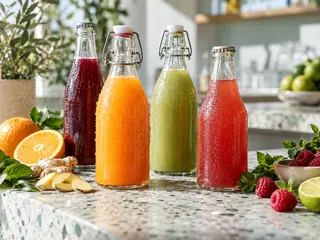
- Round juice bottles: The everyday format for orange juice, lemonade and blends. They label easily and run fast on filling lines.
- Square juice bottles: Efficient on the shelf and in cases, with four flat panels for labels. Popular for cold-pressed juice and bottled tea.
- Juice shot bottles: Small 50 to 100 ml bottles for ginger and wellness shots.
- Wide-mouth bottles and jars: Used for smoothies, milk and drinks with pulp or pieces. A glass juice jar is easier to fill with thick products.
- Swing-top bottles: Resealable bottles for lemonade, cold brew and gifting. See our swing-top bottles guide.
For tea bottles and cold brew glass bottles, the same round and square formats apply. Coffee and tea brands often prefer a slightly heavier, clear bottle to show the color of the drink.
What sizes do juice and milk bottles come in?
US juice packaging is usually labeled in fluid ounces, while European juice uses milliliters. The table below gives both.
| Size | Metric | Typical product |
|---|---|---|
| 2 oz | about 60 ml | Juice and wellness shots |
| 8 oz | about 237 ml | Kids' juice, single-serve milk |
| 10 oz | about 296 ml | Juice bars, cafe milk |
| 12 oz | about 355 ml | Single-serve juice and tea |
| 16 oz (1 pint) | about 473 ml | Cold-pressed juice, pint milk |
| 500 ml | 16.9 fl oz | European single-serve juice |
| 32 oz (1 quart) | about 946 ml | Family juice, quart milk |
| 1 liter | 33.8 fl oz | European multi-serve juice |
| 64 oz (half gallon) | about 1.89 L | Half gallon glass milk bottles |
| 128 oz (1 gallon) | about 3.79 L | Glass milk jug gallon, cider |
Stock glass juice bottles at Mars Glass include a flint glass juice and beverage bottle in 150 to 1000 ml with an aluminum-plastic cap, and a square glass beverage bottle in 200 to 1000 ml with a screw cap. Classic wide-mouth milk bottles and gallon milk jugs are not stock items and can be quoted as custom or sourced items.
Which glass bottles suit cold-pressed juice and juice shots?
Cold-pressed juice brands like glass because it shows color, feels premium and does not add flavor. The main constraint is processing.
High pressure processing (HPP) is the usual way to extend cold-pressed juice shelf life. It needs a container that can flex under pressure, so HPP juice is normally packed in plastic. Glass juice bottles are used for:
- Raw cold-pressed juice with a short refrigerated shelf life, sold locally.
- Juice that is thermally pasteurized, either before filling (hot-fill) or in the bottle.
- Shelf-stable juices and nectars made by larger processors.
For juice shot bottles, look for a stable base and a neck the consumer can drink from directly. A 2 oz bottle should have enough headspace to shake the product. Check that your labeler can handle the small diameter, because tiny bottles can be hard to label at speed.
What makes a glass milk bottle different?
A glass milk bottle has a wide mouth for fast filling and easy cleaning, a strong shoulder for stacking in crates, and usually thicker walls than a juice bottle. Dairies that run returnable programs need bottles that survive many wash cycles, so they specify heavier glass.
Light matters for milk. Exposure to light can cause off-flavors and break down riboflavin (vitamin B2). Clear glass offers no light protection, so keep milk in refrigerated cases out of direct light, and keep the time from bottling to sale short.
Common formats:
- Small glass milk bottles of 8 to 12 fl oz (237 to 355 ml) for cafes, hotels and schools.
- Pint and quart bottles for retail and home delivery.
- Half gallon glass milk jugs of 64 fl oz (1.89 L), the classic farm milk bottle size.
- Gallon glass milk jugs of 128 fl oz (3.79 L), usually with a finger loop handle.
Dairy is closely regulated. Confirm container, closure and labeling requirements with your state or national dairy authority before you choose a bottle.
Which caps and lids fit juice and milk bottles?
Juice bottle caps and milk bottle lids must seal, show tampering and match your capper.
| Closure | Where it is used | Notes |
|---|---|---|
| Plastic screw cap with tamper band | Juice, tea, milk | Simple, resealable, many sizes |
| Aluminum-plastic screw cap | Premium juice and tea | Metal look, plastic thread |
| Lug cap (metal twist-off) | Hot-fill juice, wide-mouth bottles | Can form a vacuum seal |
| ROPP aluminum cap | Juice shots, still drinks | Needs a roll-on capping head |
| Snap or press-on milk cap | Returnable milk bottles | Fast to apply; check tamper evidence |
| Crown cap | Carbonated juice and soda | 26 mm crown finish |
For hot-fill juice, use a liner and cap rated for the fill temperature. For milk, a tamper band or seal is expected by most retailers. Use our closure finder to narrow down a cap for a given finish, then test the combination on your own line.
Can glass juice bottles be hot-filled?
Yes. Hot-fill is common for juice in glass, often at temperatures in the range of about 185 to 195°F (85 to 90°C), depending on the product and the process approved for it. Glass handles heat well, but it is sensitive to sudden temperature changes, known as thermal shock.
To reduce breakage on a hot-fill line:
- Preheat bottles before filling, so the glass is not cold when hot juice hits it.
- Cool gradually after capping, with warm water before cold water.
- Leave enough headspace for the vacuum that forms as the product cools.
- Ask your supplier for the thermal shock rating of the bottle and run a trial on your line.
In the US, juice processors work under juice HACCP rules, and many other markets have equivalent requirements. Confirm current rules with your food safety advisor before you finalize the process.
How do you buy juice bottles wholesale?
Wholesale juice bottles and bulk glass milk bottles are bought by the pallet or container. Plan these items with your supplier:
- MOQ by item. Stock bottles can start low; at Mars Glass, the clear round glass water and juice bottle, 250 to 800 ml lists an MOQ of 1,000 pieces. Specialist bottles and custom molds need higher volumes. Our guide to MOQs and lead times explains how these are set.
- Cap supply. Order caps with the bottles and test them together.
- Decoration. Screen printing suits returnable milk bottles because there is no label to soak off. Decals and labels suit short runs and seasonal juice flavors.
- Returnable vs single trip. Returnable bottles cost more per unit but less per fill over their life. Single-trip bottles are lighter and cheaper.
- Packing. Juice and milk bottles ship best on pallets with layer pads. Check pallet height limits at your warehouse.
Key takeaways
- Single-serve glass juice bottles are usually 8 to 16 oz (237 to 473 ml); juice shots are about 2 oz (60 ml).
- Glass milk bottles are wide-mouth, often heavier, and come in pint, quart and half gallon sizes.
- HPP needs plastic, so glass juice is usually raw, hot-filled or pasteurized.
- Hot-fill in glass works with preheated bottles, gradual cooling and hot-fill rated caps.
- Choose caps for tamper evidence and your capping equipment, and test them with the bottle.
- Confirm juice and dairy packaging rules for your market before you finalize the bottle.
How Mars Glass can help
Mars Glass supplies stock and custom glass beverage bottles from Shanghai, including juice bottles from 150 ml to 1 liter with screw and aluminum-plastic caps. Stock samples are available, and we quote within one business day.
- Browse glass beverage bottles
- See the clear glass soda and juice bottle, 295 to 500 ml
- Compare still water formats in glass water bottles for brands
- Ask for samples or a quote
Frequently asked questions
What size are juice shot bottles?
Juice shot bottles usually hold 2 oz (about 60 ml), with some brands using 1.7 oz (50 ml) or up to 3.4 oz (100 ml). They are small, narrow bottles with a screw or ROPP cap. Choose the size by dose and price point, then confirm the fill level on a sample.
How many ounces is a glass milk bottle?
Common glass milk bottle sizes are a pint (16 fl oz, about 473 ml), a quart (32 fl oz, about 946 ml) and a half gallon (64 fl oz, about 1.89 liters). Small single-serve milk bottles of 8 to 12 fl oz are used in cafes and schools.
What are the most common juice bottle sizes?
In the US, 12 oz (355 ml) and 16 oz (473 ml) are the most common single-serve juice bottle sizes, followed by 8 oz, 10 oz and 32 oz. In Europe, 250 ml, 330 ml, 500 ml and 1 liter are typical.
Can you hot-fill juice into glass bottles?
Yes, glass is widely used for hot-filled juice, but glass is sensitive to sudden temperature changes. Preheat bottles, avoid cold sprays straight after filling, and use caps rated for hot fill. Test with your actual process before production.
Why is cold-pressed juice in glass not HPP treated?
High pressure processing needs a container that can flex under pressure, so it is normally done in plastic bottles. Cold-pressed juice in glass is usually sold raw with a short refrigerated shelf life, or it is thermally pasteurized.
Are glass milk bottles reusable?
Many dairies run returnable glass milk bottles that are washed and refilled many times. Returnable bottles are usually heavier than single-trip bottles so they survive repeated washing and handling.