Which bottle shape should you choose?
| Shape | Profile | Strengths | Considerations |
|---|---|---|---|
| Marasca | Square body, short shoulder, tall neck | Space-efficient on shelf and in cartons; stable; front-label friendly | Corners need careful label placement |
| Dorica | Round body, sloped shoulder | Classic Mediterranean look; easy wraparound labeling | Packs less densely than square |
| Round / cylindrical (various) | Straight sides, flat or rounded shoulder | Simple, often available from stock | Can look generic without decoration |
| Specialty / custom | Custom mold | Strong brand identity | Mold cost, longer lead time, higher MOQ |
Marasca and Dorica are established names in the trade, and many glassworks offer them in standard sizes, which keeps MOQs and closure matching simple. Custom shapes make sense once volumes are stable.
Which glass color protects olive oil best?
Light, heat and oxygen are the main causes of olive oil deterioration after bottling. Light, especially UV and blue light, speeds up oxidation and can reduce flavor and shelf life.
- Amber glass blocks most UV and much short-wavelength visible light. It offers strong protection but is less traditional for olive oil in some markets.
- Dark green (often called antique green or UVAG-type green) is the classic olive oil color and gives good protection; deeper shades protect better.
- Flint (clear) shows off the oil's color but offers little light protection. If you use it, pack the bottle in a gift box or paper tube, or apply an opaque spray coating.
Glass color reduces light exposure but does not replace good practice: fill with minimal headspace, consider nitrogen flushing where your process allows it, and store away from heat.
What sizes are common for olive oil bottles?
| Capacity | Typical use |
|---|---|
| 100 ml | Samples, tasting sets, hotel amenities, gifts |
| 250 ml | Premium and flavored oils, gift sets, trial size |
| 500 ml | Mainstream retail, premium extra virgin |
| 750 ml | Retail, popular in some markets alongside 500 ml |
| 1,000 ml | Family size, value retail, foodservice |
Check the permitted nominal quantities and labeling rules for each target market. Smaller bottles cost more per liter of oil but suit premium and gift positioning, and they reduce the time an opened bottle sits in a kitchen.
Which closure should you use on an olive oil bottle?
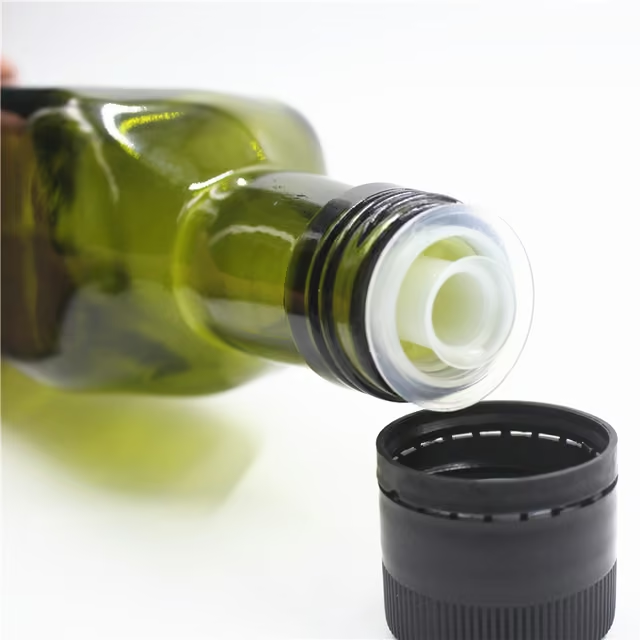
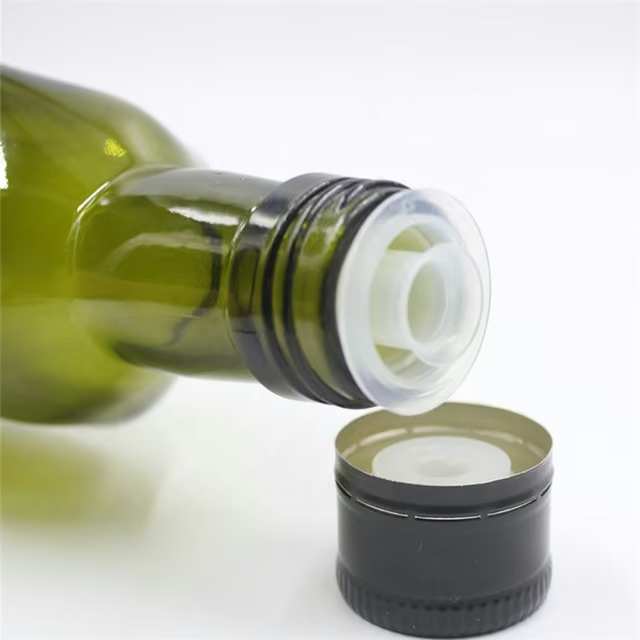
The most common system is the 31.5×24 mm finish with an aluminum cap that contains a plastic pourer insert. The pourer controls flow and reduces dripping down the bottle. The aluminum shell is usually applied as roll-on pilfer-proof (ROPP), so it carries a tamper-evident band that breaks on first opening.
Other options:
- Non-refillable (NR) fitments: inserts with a valve that lets oil pour out but prevents refilling. Used where foodservice rules require non-reusable openings, and to discourage counterfeiting.
- Screw caps on GPI finishes (for example 28-400 or 33-400 style) for some designs, with a liner suitable for oil.
- Cork T-stoppers on bar-top finishes for gift and premium editions, though they are less common for daily use.
ROPP caps need capping equipment set up for the size. If you fill by hand at small scale, discuss this with your supplier before committing.
What about tamper evidence and non-refillable rules?
Tamper evidence shows the consumer that the bottle has not been opened. On ROPP caps it is the perforated band; on screw caps it is a breakable ring or a shrink band.
In the EU, olive oil served to consumers in hotels, restaurants and catering generally must be in pre-packaged containers with an opening system that cannot be reused once the original contents are used up, and with proper labeling. Requirements in other countries differ. Confirm the current rules with your importer or regulatory advisor; your closure supplier can then propose suitable fitments.
How should you plan labeling?
- Decide early between paper labels, screen printing or both, because label area depends on bottle shape.
- Marasca gives flat front and back panels; Dorica suits wraparound labels.
- Oil can stain paper labels: choose oil-resistant label stock or a coated paper, and design the pourer to reduce drips.
- Leave room for mandatory information such as product category, net quantity, origin, best-before date, storage advice and lot number, according to your market's rules.
- For premium positioning, consider screen printing, hot stamping or frosting on the glass, and a printed gift box or paper tube for light protection and shelf impact.
How do you choose an olive oil bottle step by step?
- Define channel and price point: retail, gift, foodservice, export.
- Choose capacity per channel.
- Choose glass color based on light exposure in your supply chain.
- Choose shape (Marasca, Dorica, round, or custom) and check label area.
- Choose the finish and closure system (usually 31.5×24 mm with pourer), plus NR fitment if required.
- Order matched samples of bottle and cap, fill with your oil and test pouring, sealing and leakage.
- Approve decoration, labels and outer packaging.
- Confirm MOQ, lead time and packing method, then place the order.
Mars Glass supplies olive oil bottles, 31.5×24 mm oil pourer caps, 28 mm ROPP caps and printed gift boxes and paper tubes, so bottle, closure and outer packaging can be sampled together.
Key takeaways
- Dark green or amber glass protects olive oil from light better than flint.
- Marasca (square) packs efficiently; Dorica (round) gives a classic look.
- Common sizes run from 100 ml to 1,000 ml; choose by channel.
- The 31.5×24 mm finish with an aluminum pourer cap is the most common closure system.
- Use tamper-evident closures, and non-refillable fitments where foodservice rules require them.
- Test bottle, cap and oil together before mass production.
Frequently asked questions
What is the best bottle color for olive oil?
Dark green or amber glass gives better protection against light than clear flint glass, which helps slow oxidation during display. If you choose clear glass, use outer packaging such as a gift box or tube, or an opaque coating.
What is the difference between Marasca and Dorica bottles?
Marasca bottles have a square cross-section with a tall body and short shoulder, which packs efficiently and suits wraparound or front labels. Dorica bottles are round with a gently sloping shoulder and a more traditional look.
What cap fits a standard olive oil bottle?
Many olive oil bottles use a 31.5×24 mm finish, closed with an aluminum ROPP-style cap that has a plastic pourer insert. Some bottles use other finishes, so check the bottle drawing before ordering closures.
Do restaurants need non-refillable olive oil bottles?
In the EU, olive oil offered to consumers in hotels, restaurants and catering must generally be in labeled containers with an opening that cannot be reused once the original contents are finished. Check the current rules for your market.